
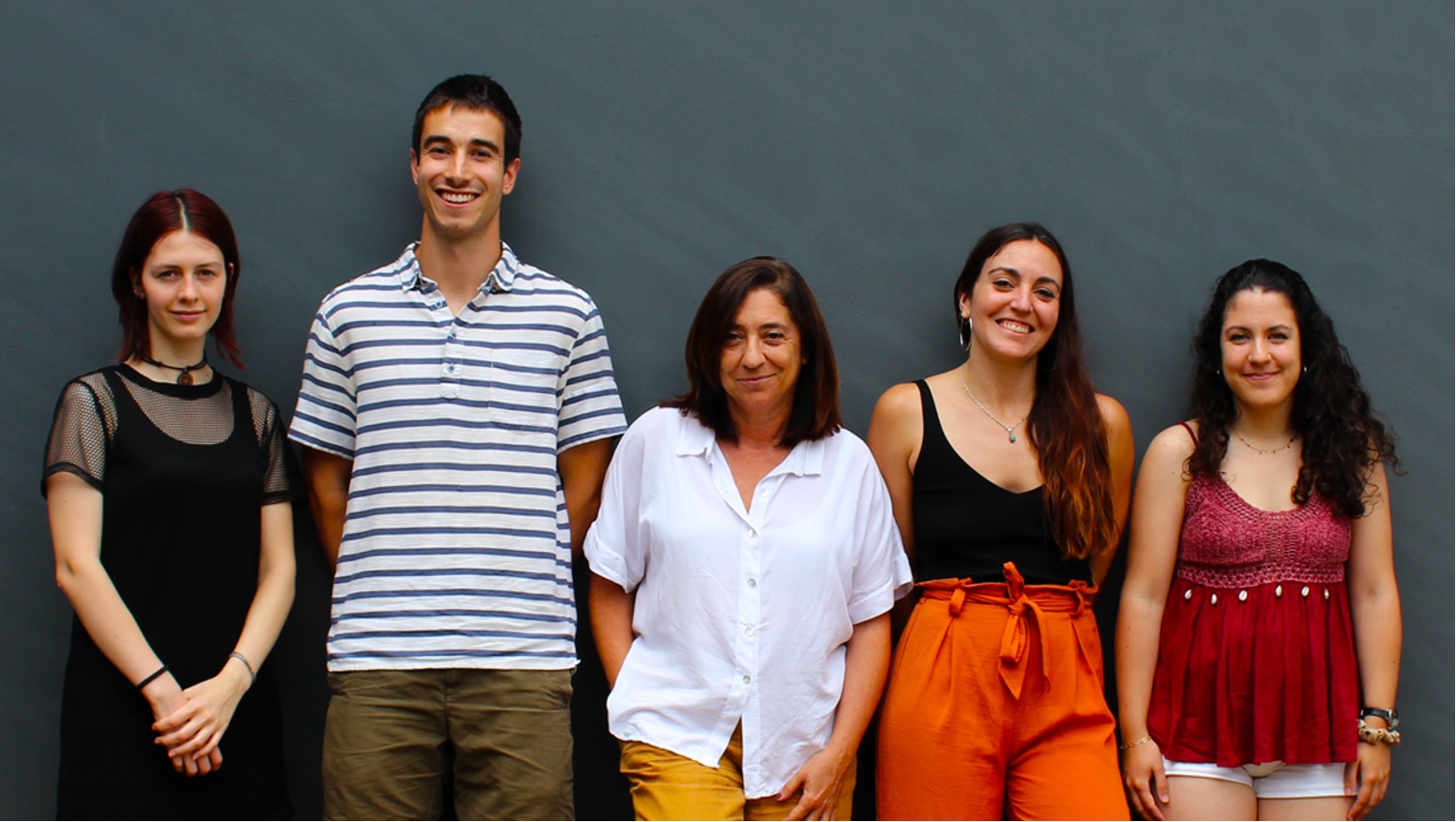
Group photo. From left to right, Josephine Hotten, Pablo Guridi, Macxalen Llosa, Dolores Lucía Guzmán-Herrador, Andrea Fernández-Gómez.
The team led by Matxalen Llosa, Professor of Genetics at the University of Cantabria, is one of the 10 groups that founded the Institute of Biomedicine and Biotechnology of Cantabria (IBBTEC) in 2007, a Joint Center between the University of Cantabria and the CSIC.
Our scientific interests focus on bacterial communication mediated by Type IV Secretion Systems (T4SS). These macromolecular complexes are capable of translocating specific substrates across the membranes of gram-negative bacteria. What differentiates them from other secretion systems and makes them of greater interest is their plasticity, being capable of secreting both proteins and DNA and nucleoprotein complexes, both to the extracellular medium and to another recipient cell, whether prokaryotic or eukaryotic (Bleves et al, 2020). This translates into enormous biological versatility: T4SS are part of the conjugative machineries to mediate horizontal genetic transfer between bacteria, they are involved in the secretion of virulence factors to animal cells, they also play a role in symbiotic relationships between bacteria and plant cells, they inject toxins into competing bacteria, and they are capable of secreting-importing DNA from the extracellular environment. These characteristics make them an interesting object of study both from a biological, biotechnological and biomedical point of view. One of our goals is to take advantage of its promiscuity to reach virtually any cell type. Based on the molecular knowledge we have of these processes, we also intend to use these systems to develop tools for introducing DNA and proteins into wild bacteria that are difficult to handle. As a first step, we are expanding the range of wild bacteria susceptible to being modified by conjugation from E. coli (Fig. 1; Samperio et al, 2001).
Our work also focuses on deciphering the molecular basis of substrate recruitment. Some time ago we demonstrated that substrates can be exchanged between T4SS involved in conjugation and virulence (Llosa et al, 2012): nucleoprotein complexes consisting of the conjugative relaxase covalently linked to the transferred DNA strand, can be recognized and translocated by the T4SS involved in the virulence of human pathogens. A very significant result of the group has been to show that substrates can be exchanged between T4SS involved in conjugation and virulence. Thus, we have shown that the nucleoprotein complexes that are transferred through the T4SS during bacterial conjugation, consisting of the conjugative relaxase covalently bound to the transferred DNA strand, can be recognized and translocated by the T4SS involved in the virulence of pathogens. humans O Coxiella burnetii (Guzmán-Herrador et al, 2017). This result could be observed with minimal manipulation of natural systems, arguing that it possibly reflects a natural phenomenon. Our current objective is to demonstrate whether this genetic transfer indeed occurs in nature, and to discover the biological role it may play, either by contributing to the virulence of the pathogen that encodes the T4SS, or by contributing to possible symbiotic relationships of the microbiome with its host. With this objective, we have developed a system for detecting and analyzing bacterial DNA integration in the genome of human cells infected by bacteria, and we are studying the integration pattern and the potential underlying mechanism. The ability of T4SS from pathogenic bacteria to transfer nucleoprotein complexes also opens the door to the use of T4SS to deliver DNA of interest in vivo directly to human cells of choice, which would be different depending on the tropism of the pathogen of choice. Furthermore, we have seen that DNA guided by relaxase is more likely to be integrated into the recipient genome (González-Prieto et al., 2017).
The group is also an expert in the study of conjugative relaxases (Guzmán-Herrador and Llosa, 2019). We were pioneers in showing that these proteins are translocated to recipient cells, where they are functional and necessary to complete the conjugative process (Draper et al 2005). We are analyzing in bacteria the set of proteins that are transferred by conjugation apart from relaxase, and the requirements for these proteins to be secreted. The applied aspect of this line of work consists of manipulating secretion signals to customize heterologous secretion (Guzmán-Herrador et al, 2023). Using conjugative relaxases as drivers to transfer other proteins of interest directly to the conjugation recipient cell, we have delivered Cas nucleases and base editors fused to conjugative relaxases, and show that these fusion proteins are active in recipient cells. This allows genetic information machinery to be sent to any conjugation recipient bacteria without the need to adapt it to the expression signals of the recipient, and without the risk of overexpressing nucleases that would entail off-target activity and toxicity (Guzmán-Herrador et al, 2024).
Finally, a recent line of research focuses on creating tools to monitor the horizontal transfer of plasmids in natural environments. The basis is the creation of mobilizable plasmids capable of storing the information of the cells they visit by acquiring spacers in their own array. These plasmids will make it possible to follow the trajectory of individual mobile genetic elements within complex mixtures of bacteria in natural samples, which will provide valuable information on the spread of plasmids in nature, including the information they encode, such as antibiotic resistance.
Our scientific interests focus on bacterial communication mediated by Type IV Secretion Systems (T4SS). These macromolecular complexes, like other families of secretion systems, are capable of translocating specific substrates across the membranes of gram-negative bacteria. What differentiates them from other systems and endows them with greater interest is their plasticity, being capable of secreting proteins as well as DNA and nucleoprotein complexes, both to the extracellular medium and to another recipient cell, whether prokaryotic or eukaryotic. This translates into an enormous biological versatility: the T4SS are part of the conjugative machinery to mediate horizontal gene transfer between bacteria, they are involved in the secretion of virulence factors to animal cells, they also play a role in symbiotic relationships between bacteria and animal cells. plants, inject toxins into competing bacteria, and are capable of secreting-importing DNA from the extracellular medium. These characteristics make them an interesting object of study from a biological, biotechnological and biomedical point of view. Based on the molecular knowledge we have of these processes, our group also intends to use these systems to develop tools for the introduction and site-specific integration of DNA in human cells.
A part of our work focuses on the comparative study of T4SS belonging to conjugative systems and pathogenic bacteria. Our study models are the T4SS of the conjugative plasmid R388, and the T4SS VirB/D4 of A part of our work focuses on the comparative study of T4SS belonging to conjugative systems and pathogenic bacteria. Our study models are the T4SS of the conjugative plasmid R388, and the T4SS VirB/D4 ofA part of our work focuses on the comparative study of T4SS belonging to conjugative systems and pathogenic bacteria. Our study models are the T4SS of the conjugative plasmid R388, and the T4SS VirB/D4 of
A very significant result of the group has been to show that substrates can be exchanged between T4SS involved in conjugation and virulence. Thus, we have shown that the nucleoprotein complexes that are transferred through the T4SS during bacterial conjugation, consisting of the conjugative relaxase covalently bound to the transferred DNA strand, can be recognized and translocated by the T4SS involved in the virulence of pathogens. humans A very significant result of the group has been to show that substrates can be exchanged between T4SS involved in conjugation and virulence. Thus, we have shown that the nucleoprotein complexes that are transferred through the T4SS during bacterial conjugation, consisting of the conjugative relaxase covalently bound to the transferred DNA strand, can be recognized and translocated by the T4SS involved in the virulence of pathogens. humans O A very significant result of the group has been to show that substrates can be exchanged between T4SS involved in conjugation and virulence. Thus, we have shown that the nucleoprotein complexes that are transferred through the T4SS during bacterial conjugation, consisting of the conjugative relaxase covalently bound to the transferred DNA strand, can be recognized and translocated by the T4SS involved in the virulence of pathogens. humans A very significant result of the group has been to show that substrates can be exchanged between T4SS involved in conjugation and virulence. Thus, we have shown that the nucleoprotein complexes that are transferred through the T4SS during bacterial conjugation, consisting of the conjugative relaxase covalently bound to the transferred DNA strand, can be recognized and translocated by the T4SS involved in the virulence of pathogens. humans
This result could be observed with little or no manipulation of natural systems, arguing that it possibly reflects a natural phenomenon, and horizontal DNA transfer between pathogens and their host cells, mediated by T4SS, may occur. Our current goal is to demonstrate whether this gene transfer does indeed occur in nature, and to discover the biological role it may play, either by contributing to the virulence of the pathogen encoded by T4SS, or by contributing to possible symbiotic relationships of the microbiome with its host.
The applied aspect of this line consists of manipulating the T4SS of different pathogenic bacteria so that they secrete DNA molecules of interest in vivo directly to the human cells of choice, which would be different depending on the tropism of the pathogen of choice.
Another line of work focuses on the characterization of conjugative relaxases, the proteins that process and guide DNA to the recipient cell during conjugation. Our model is the relaxase of the conjugative system of R388, TrwC. This protein, in addition to its role in conjugation, has site-specific recombinase and integrase activity in the recipient bacteria, an activity that we have characterized in bacteria and are testing in human cells. One of our challenges is to elucidate what would be the biological role of this unexpected activity, which curiously is shared by some, but not all conjugative relaxases analyzed. Our data indicate that, although the protein initiates recombination/integration reactions with high sequence specificity for its specific target, the targeting in the recipient cell is more lax. This leads us to think that such a system could provide the conjugative plasmid with a colonization system for non-permissive hosts (i.e. bacteria to which the plasmid can conjugate, but where it could not replicate), promoting its integration into the recipient genome.
By fine-tuning the T4SS DNA transfer assay of human pathogens, we have also studied the activity of TrwC and other relaxases after being transferred into human cells, discovering that relaxase enhances integration into cells by two orders of magnitude. the human genome of DNA transferred from the bacterium. This integration is not site-specific, although we are developing different strategies to make it so. Although we are still in the proof-of-concept stage, the potential applications are enormous.
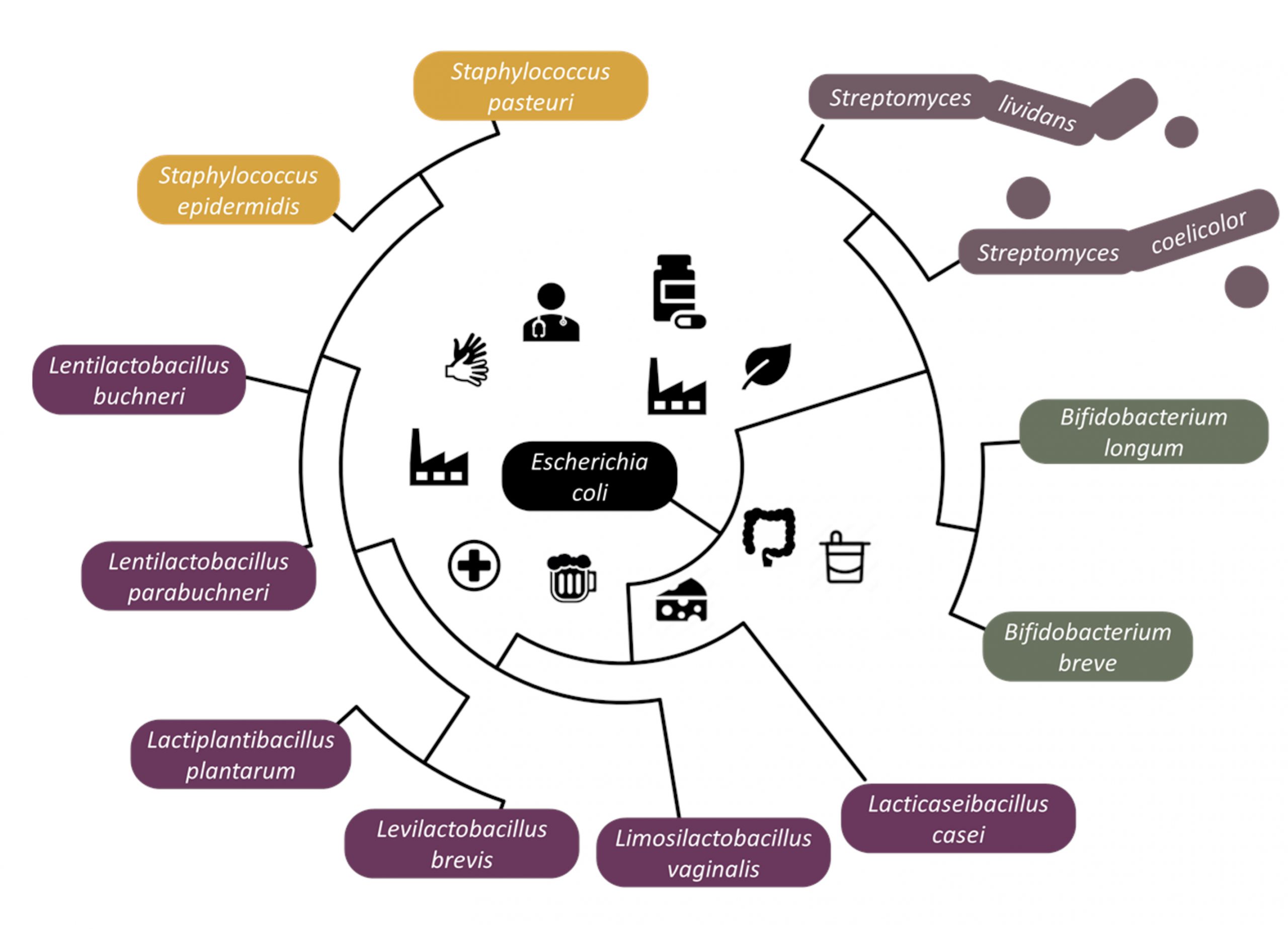
Figure. Gram-positive bacteria of biotechnological and biomedical interest that we have modified by conjugation since E. coli
References cited
-
- Bleves S, Galán J, Llosa M* (2020). Bacterial injection machines: evolutionary diverse but functionally convergent. Cell Microbiol. 22(5):e13157. doi: 10.1111/cmi.13157
- Draper O, César CE, Machón C, de la Cruz F, Llosa M* (2005). Site-specific recombinase and integrase activities of a conjugative relaxase in the recipient cell. Proc Natl Acad Sci USA 102: 16385-16390
- González-Prieto C, Gabriel R, Dehio C, Schmidt M, LlosaM* (2017). The Conjugative Relaxase TrwC Promotes Integration of Foreign DNA in the Human Genome.
Appl Environ Microbiol. 83:e00207-17. doi: 10.1128/AEM.00207-17. - Guzmán-Herrador DL, Llosa M* (2019). The secret life of conjugative relaxases. Plasmid 104:102415. https://doi.org/10.1016/j.plasmid.2019.102415
- Guzmán-Herrador DL, Fernández-Gómez A, Llosa M* (2023). Recruitment of heterologous substrates by bacterial secretion systems for transkingdom translocation. Front Cell Infect Microbiol. 13:1146000. doi: 10.3389/fcimb.2023.1146000.
- Guzmán-Herrador DL, Fernández-Gómez A, Depardieu F, Bikard D*, Llosa M* (2024). In vivo delivery of functional Cas:DNA nucleoprotein complexes into recipient bacteria through a Type IV Secretion System. Natl. Acad. Sci. USA 121(43):e2408509121. doi: 10.1073/pnas.2408509121
- Llosa M, Schröder G, Dehio C (2012). New perspectives into bacterial DNA transfer to human cells. Trends Microbiol 20(8): 355-359
- Samperio S, Guzmán-Herrador DL, May-Cuz R, Martín MC, Álvarez MA, Llosa M* (2021). Conjugative DNA Transfer from colito Transformation-Resistant Lactobacilli. Front Microbiol. 12:606629. doi: 10.3389/fmicb.2021.606629.